
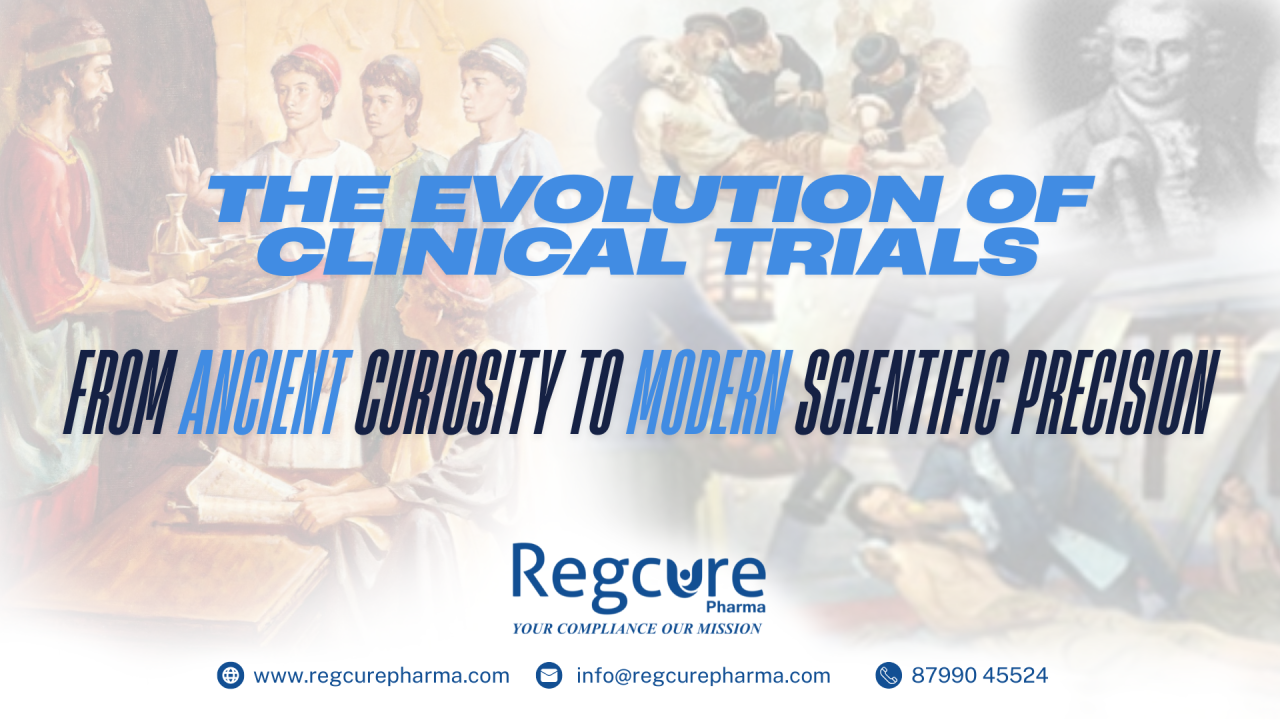
Introduction to the History of Clinical Trials
Clinical trials have shaped modern medicine, transforming observations into scientific breakthroughs that save millions of lives. This timeline captures the remarkable evolution — from ancient experiments to today’s technology-driven, ethically governed research ecosystem.
World’s First Clinical Trial

The origins of clinical experimentation can be traced First Clinical Trial First Clinical Trialback over 2,500 years to an event described in the Book of Daniel from the Bible, around 500 BC. This ancient record details what is now recognized as one of the earliest documented clinical studies—a simple yet insightful nutritional experiment.
King Nebuchadnezzar of Babylon believed that a diet rich in meat and wine would maintain his subjects’ strength and vitality. However, a group of young men, including Daniel, chose to follow a plant-based diet consisting of legumes and water.
After ten days, the outcome was remarkable, those who consumed the vegetarian diet appeared healthier and more nourished than those who followed the royal meal plan. Impressed by the results, the king allowed them to continue their chosen diet.
This experiment, although uncontrolled and observational, represents the foundation of evidence-based health assessment. It demonstrated how systematic observation and comparison could be used to draw meaningful conclusions about health and nutrition centuries before modern medicine defined the concept of a clinical trial.
Today, the “Daniel Experiment” stands as an early symbol of the scientific spirit of inquiry, showing humanity’s first steps toward evaluating the effects of interventions on health outcomes — a core principle that continues to shape modern clinical research.
In 1025 AD, the Persian physician Ibn Sīnā, known in the West as Avicenna, made significant contributions to clinical research with his encyclopaedic work, the “Canon of Medicine.” He proposed that remedies should be tested in their natural state on individuals with uncomplicated diseases. His guidelines emphasized a systematic approach to drug testing, reflecting principles that align with contemporary clinical trials.
Both historical examples highlight the evolution of clinical experimentation, showcasing early efforts to understand and improve health through systematic investigation. These foundational practices laid the groundwork for modern clinical research methodologies.
A Happy Accident: Trial of a Novel Therapy

The first clinical trial of a novel therapy was conducted accidentally by the famous surgeon Ambroise Pare in 1537. After running out of boiling elderberry oil for treating battlefield wounds, Paré used an alternative ointment made of turpentine, egg yolk, and rose oil.
Despite his initial concerns, the ointment proved more effective than the standard treatment, causing less pain and irritation while improving outcomes. This accidental discovery led Paré to abandon cauterization and marked a significant advancement in medical care through empirical experimentation. His observation set a precedent for future medical practices and innovations.
The modern era- from James Lind’s scurvy trial to randomization- 1747
James Lind, a Scottish surgeon, “Father of Clinical Trials” conducted the first modern controlled clinical trial in the 18th century to address scurvy among sailors. By assigning different dietary regimens to groups of patients, he discovered that oranges and lemons, rich in vitamin C, were most effective in preventing scurvy. Despite his findings, the use of citrus fruits was not adopted until 50 years later, with lime juice eventually replacing lemons due to cost.
In 2003, the James Lind Library was established to honor his work and promote understanding of fair treatment testing, leading to the designation of May 20 as International Clinical Trials Day. The Association of Clinical Research Professionals has organized this day to celebrate advancements in clinical research.
The first use of a placebo in a clinical trial – 1800
The arrival of the placebo marked another important breakthrough in the history of clinical research. The concept of the placebo began to take shape in the early 1800s, with the term first appearing in medical literature. It wasn’t until 1863 that U.S. physician Austin Flint conducted the first clinical study comparing a placebo to an active treatment for rheumatism. Flint’s study, described in his 1886 book, demonstrated how a dummy remedy could gain patient confidence, marking a key development in clinical trial methodology.
1906 – The Birth of Modern Drug Regulation: The Pure Food and Drugs Act
The year 1906 marked a defining moment in the history of public health and clinical research with the introduction of the Pure Food and Drugs Act in the United States. This landmark legislation was the first federal law designed to protect consumers from unsafe and mislabeled food and drug products, laying the foundation for modern drug regulation and scientific integrity in healthcare.
Before this act, the American marketplace was flooded with unregulated medicines and tonics, many of which contained harmful substances or made false therapeutic claims. There were no standardized requirements for drug safety, purity, or efficacy, leaving patients vulnerable to exploitation and serious health risks.
The Pure Food and Drugs Act changed this landscape entirely. It required that medicines and food products be truthfully labeled, ensuring that consumers were informed about what they were purchasing and consuming. This was a major leap toward accountability, transparency, and patient safety in medical science.
The passage of this act also led to the establishment of what would become the U.S. Food and Drug Administration (FDA) — a regulatory authority that continues to play a pivotal role in ensuring the safety, quality, and efficacy of drugs, vaccines, and medical devices worldwide.
This reform not only strengthened the ethical foundation of pharmaceutical research but also marked the beginning of government oversight in clinical testing and drug development. The 1906 Act paved the way for future regulations that would refine and expand drug approval processes — ultimately shaping the modern framework for clinical trials, pharmacovigilance, and patient protection.
In essence, the Pure Food and Drugs Act of 1906 represents more than just a legal milestone; it symbolizes the start of a new era of trust, safety, and scientific validation in medicine — principles that remain central to clinical research today.
Next stage by following the Sulfa Craze of 1937, which resulted in 107 deaths from improperly prepared sulfa drugs, the Federal Food, Drug, and Cosmetic Act of 1938 was enacted. This legislation mandated toxicological testing for new drugs to ensure their safety before they could be marketed.
First Double-Blind Clinical Trial – 1943

In 1943, the UK Medical Research Council conducted the first double-blind comparative clinical trial to test patulin, an extract of Penicillium patulinum, for the common cold. The study was meticulously controlled, with both physicians and patients blinded to the treatment. Although patulin was not found effective, the trial established a model for future double-blind studies.
First Randomized Curative Trial – 1946
In 1946, nearly 200 years after James Lind’s first clinical trial, the UK Medical Research Council conducted the first randomized controlled trial of streptomycin for pulmonary tuberculosis. Faced with a shortage of the drug, they randomly assigned participants to treatment and control groups, eliminating biases in patient assignment. This landmark study established randomization as a standard practice in clinical trials and marked the beginning of a “new era of medicine.”
Evolution of Ethical and Regulatory Framework
In the early 20th century, scientific advancements in clinical trials accelerated rapidly, but the 1930s and 40s saw unethical experiments, including deliberately infecting a baby with herpes and testing drugs on prisoners, as well as atrocities in World War II concentration camps. These abuses highlighted the urgent need for a stronger focus on ethical standards in clinical research.
Nuremberg Code – 1947
The Nuremberg Code, established in 1947, was the first international set of ethical guidelines for medical research involving human subjects. It is a set of research ethics principles for human experimentation.
Thalidomide Tragedy in 1961 the drug was taken off from the market due to deformed limbs and defective organs in children who took thalidomide in pregnancy as a treatment of morning sickness.
1948 – The First Randomized Controlled Trial (RCT) and the Birth of the Gold Standard in Clinical Research
The year 1948 marked a major milestone in medical research with the completion of the first randomized controlled trial (RCT) to study pulmonary tuberculosis. This landmark study introduced a method of systematic randomization, ensuring that patients were assigned to treatment or control groups purely by chance, thereby eliminating selection bias and providing more reliable results.
Before this breakthrough, clinical studies often relied on observational methods or uncontrolled comparisons, which made it difficult to determine whether treatments were truly effective. The 1948 tuberculosis trial changed this paradigm by introducing rigorous scientific methodology, which allowed researchers to measure the actual efficacy of interventions with unprecedented accuracy.
The success of this RCT not only validated the treatment for tuberculosis but also established randomized controlled trials as the gold standard in clinical research — a principle that continues to guide the development of drugs, vaccines, and therapies worldwide.
Today, RCTs form the backbone of evidence-based medicine, providing the highest level of clinical evidence for determining the safety and effectiveness of new treatments. The 1948 trial laid the foundation for decades of innovation in clinical trial design, patient safety, and regulatory science, shaping the way modern medicine evaluates therapies and saves lives.
In essence, the first RCT was more than just a single study; it was the beginning of a new era in medical science, one defined by objectivity, reliability, and scientific rigor — principles that continue to underpin all clinical research today.
Declaration of Helsinki – 1964
The World Medical Association has developed the declaration of Helsinki as a statement of ethical principles to provide guidance to physicians and other participants in medical research involving human subjects. The basic principles include respect for individuals, the right to make informed decisions, recognition of vulnerable groups. It has been revised six times in 1975,1983,1989,1996,2000 & 2008.
In 1966, the International Covenant on Civil and Political Rights declared that no one should face torture or cruel, inhuman treatment, and emphasized the need for consent in medical and scientific treatment. Dr. Henry Beecher’s 1966 study on research abuses, along with the revelation of the Tuskegee study’s unethical practices in the 1970s, heightened the push for stricter regulation of government-funded research.
1967 – Development of the First Effective Mumps Vaccine
In 1967, a major breakthrough in preventive medicine was achieved with the development of the first effective vaccine against mumps. Remarkably, this vaccine was developed in just four years, demonstrating the potential for rapid scientific innovation when there is a pressing public health need.
Mumps, a highly contagious viral infection, had long been a significant cause of childhood illness, leading to complications such as meningitis, hearing loss, and infertility in severe cases. The introduction of this vaccine represented a monumental step forward in infectious disease control and public health protection.
The rapid development and successful deployment of the mumps vaccine highlighted several key aspects of modern clinical research:
- Accelerated vaccine research is possible without compromising safety and efficacy when guided by rigorous clinical trials.
- Collaborative scientific effort between researchers, clinicians, and regulatory bodies is critical for timely breakthroughs.
- The importance of systematic testing, monitoring, and evaluation in ensuring vaccine safety and public trust.
The 1967 mumps vaccine became a cornerstone in childhood immunization programs worldwide, setting a precedent for how vaccines can be developed, tested, and implemented efficiently. It also foreshadowed future rapid responses to emerging infectious diseases, proving that scientific innovation can keep pace with public health demands.
This achievement not only protected millions of children from mumps but also underscored the transformative power of vaccines — a principle that remains central to global health initiatives today.
Belmont report – 1978
It was established by the National Commission for the Protection of Human Subjects of Biomedical and Behavioral Research to outline ethical principles and guidelines for safeguarding human subjects in research. The core principles include respect for persons, beneficence, and justice.
1995 – Establishment of the European Medicines Agency (EMA)
In 1995, the European Medicines Agency (EMA) was established as a major milestone in the regulation and oversight of pharmaceuticals across the European Union (EU). The EMA was created to harmonize the evaluation, approval, and monitoring of medicines across all EU member states, ensuring that safe and effective treatments reach patients efficiently and consistently.
Before the EMA, each EU country had its own regulatory framework, which often led to duplication of efforts, inconsistent standards, and delays in making medicines available to patients. The EMA addressed these challenges by providing a centralized platform for scientific evaluation, fostering collaboration among national regulatory authorities, pharmaceutical companies, and healthcare professionals.
Key objectives of the EMA include:
- Ensuring medicine safety and efficacy through rigorous evaluation and continuous monitoring.
- Streamlining drug approval processes to accelerate access to innovative therapies.
- Supporting research and development by providing guidance to pharmaceutical companies on regulatory requirements.
- Facilitating collaboration among EU member states for consistent healthcare standards.
The creation of the EMA marked a significant step toward global regulatory harmonization, influencing international standards and reinforcing the importance of scientifically sound, patient-focused clinical trials.
Today, the EMA continues to play a pivotal role in protecting public health, promoting innovation, and ensuring that high-quality medicines are available to millions of patients across Europe and beyond.
The ICH-GCP Guidelines: The Pillar of Clinical Trials – 1997
To address international inconsistencies and improve global standards, the International Conference for Harmonisation of Technical Requirements for Registration of Pharmaceuticals for Human Use (ICH) issued the ICH Guidelines: Topic E6 for Good Clinical Practice (GCP), which were approved on July 17, 1996, and implemented from January 17, 1997
The ICH-GCP guidelines are considered the definitive framework for clinical trials and are continually evolving. Following the release of the ICH E6(R2) guidelines in 2016, which addressed advances in technology and trial complexity, the ICH introduced a draft for the ICH E6 (R3) guidelines in May 2023. These guidelines establish standards for protecting the rights, safety, and welfare of clinical trial participants while ensuring the credibility and quality of data collected.
Evolution of Clinical Trials in India
India has recently been recognized as an attractive country for clinical trials. In 1945, a Clinical Research Unit – the first research unit of IRFA attached to a medical institution- was established at the Indian Cancer Research Centre, Bombay.
In 1949, IRFA was redesignated as the Indian Council of Medical Research. The Central Ethical Committee of ICMR on Human Research constituted under the Chairmanship of Hon’ble Justice (Retired) M.N. Venkatachalam held its first meeting on September 10, 1996. The committee released Ethical Guidelines for Biomedical Research on Human Participants in 2000 which were revised in 2006. Schedule Y of Drugs and Cosmetics Act came into force in 1988 and established the regulatory guidelines for clinical trial (CT) permission.
The DCGI is the government official who grants permission for new drugs to be administered to human subjects in clinical trials conducted in the country
Meanwhile in 2001, the CDSCO released guidelines on Indian Good Clinical Practice. The central government, via the Central Drug Standard Control Organization (CDSCO) under the Ministry of Health and Family Welfare, regulates drug manufacturing, sales, clinical trials and, import and export in India.
2010 – Digital Transformation in Clinical Trials
By 2010, the pharmaceutical and clinical research industry began integrating digital and cloud-based technologies into the design and execution of clinical trials. This marked a major shift in how data was collected, stored, and analyzed, enabling greater efficiency, accuracy, and transparency in research.
Key advancements during this period included:
- Electronic Data Capture (EDC): Replacing traditional paper records with digital systems to streamline data entry and management.
- Cloud Platforms: Allowing secure, real-time access to trial data across multiple sites and stakeholders.
- Remote Monitoring Tools: Facilitating oversight of trial sites and participants without the need for constant physical visits.
- Analytics and Visualization: Using software to detect trends, anomalies, and ensure data integrity in near real-time.
This digital transformation laid the foundation for modern decentralized and hybrid clinical trials, enhancing patient accessibility, speeding up research timelines, and improving the overall quality and reliability of clinical data.
2020 – Rapid Development of COVID-19 Vaccines
The year 2020 will be remembered as a defining moment in global healthcare. In response to the COVID-19 pandemic, vaccines were developed, tested, and granted emergency-use authorization in just 11 months — a record-breaking timeline in the history of medicine.
This unprecedented achievement showcased several critical factors:
- Global Collaboration: Governments, research institutions, and pharmaceutical companies worked together across borders.
- Accelerated Clinical Trials: Adaptive trial designs and streamlined regulatory pathways allowed faster yet safe evaluation of vaccine efficacy.
- Advanced Technology Utilization: mRNA platforms, AI-driven data analysis, and real-time monitoring significantly reduced development timelines.
- Public Health Impact: Millions of doses were administered worldwide, demonstrating how rapid scientific innovation can respond to urgent global health crises.
The COVID-19 vaccine development not only saved countless lives but also redefined the future of clinical research, highlighting the potential for speed, efficiency, and collaboration without compromising safety or scientific rigor.
A Brief History of Clinical Trials

📩 Reach out to Regcure Pharma For expert regulatory support, clinical research insights, and end-to-end healthcare solutions: 📧 info@regcurepharma.com | 🌐 www.regcurepharma.com | 📞87990 45524